We live in a world where first impressions are made in milliseconds. Before a potential client reads a single word of your pitch, before they click a button or scroll a page, they’ve already felt something about your product. And that feeling? It lives entirely in the visual.
For designers, developers, and marketers, the humble laptop mockup has long been one of the most powerful tools in the visual storytelling arsenal. But something big is happening. The static image pinned to a Behance portfolio is evolving — rapidly — into something far more immersive, intelligent, and interactive. Augmented reality, virtual reality, and artificial intelligence aren’t just buzzwords from a Silicon Valley keynote. They’re actively rewriting the rules of how digital products get presented, sold, and experienced.
Let’s take a walk into that future.
From Flat Screens to Living Spaces: The AR Revolution
Remember when showing a client your app meant emailing a PDF or screensharing a Figma prototype? Those days are numbered.
Augmented reality is transforming product presentation into a spatial experience. Imagine placing a virtual laptop on an actual conference table — the client reaches out instinctively, almost expecting to touch it. AR lets designers overlay their interface mockups onto real-world environments, allowing stakeholders to feel the product in context rather than imagining it from a flat JPEG.
Apple’s Vision Pro and similar mixed-reality headsets are pushing this even further. Designers are beginning to build AR-ready presentation decks where a laptop mockup doesn’t just sit on a slide — it floats in the room, rotatable, scalable, alive. Agencies in Tokyo, Amsterdam, and New York are already pitching clients this way.
The implication? Mockup creation is no longer just a graphic design skill. It’s becoming a spatial design discipline.
Virtual Showrooms: VR and the Death of the PDF Deck
If AR brings products into your space, VR pulls your client into yours.
Virtual reality showrooms are quietly becoming the new pitch meetings. Instead of a Zoom call with a shared screen, imagine inviting a client into a fully rendered digital studio — walls lined with their branding, their app displayed across multiple device mockups in a curated environment, ambient lighting adjusting to match their company colors.
This isn’t science fiction. Platforms are already being built where designers can construct virtual galleries for product presentations. A laptop mockup in this context doesn’t just show what the interface looks like — it demonstrates how it lives alongside other design elements, in motion, in space.
The key advantages of VR product presentations include:
- Emotional immersion — clients don’t just evaluate, they experience
- Contextual storytelling — show the product in a realistic use environment
- Reduced revision cycles — spatial clarity means fewer misunderstandings early on
- Global accessibility — no flights, no boardrooms, just presence
AI Steps Into the Studio
Artificial intelligence is perhaps the most quietly radical force reshaping mockup culture.
AI tools are now capable of generating entire lifestyle scenes around a device in seconds. Feed an AI the color palette of your brand, describe the mood — “Nordic morning, minimalist desk, soft shadows” — and it builds the context around your laptop mockup automatically. What once took a photographer, a set designer, and a post-production team can now be iterated upon in real time.
Beyond scene generation, AI is changing how mockups are adapted. Smart scaling, automatic lighting adjustment based on the interface color scheme, and real-time background removal are becoming standard features. Some tools can even analyze your app’s UI and suggest the most flattering angle or composition for your mockup automatically.
This creates a genuinely exciting shift: designers spend less time on production busywork and more time on the thing that actually matters — creative direction.
Premium Mockups Today: What ls.graphics Brings to the Table
Before fully surrendering to the algorithm, it’s worth acknowledging what exceptional human-crafted mockup resources still offer — and why platforms like ls.graphics remain essential reference points in any serious designer’s toolkit.
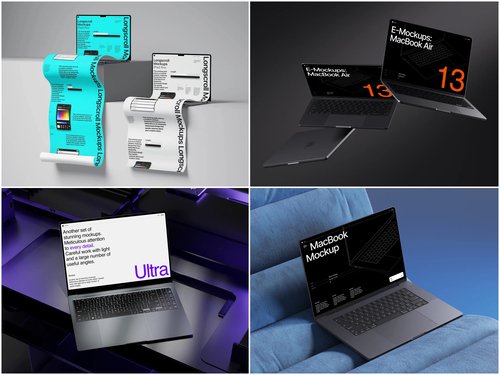
The laptop mockup collections available on ls.graphics represent a benchmark in quality. Here’s what sets them apart:
- Ultra-realistic rendering that captures light, shadow, and surface texture with photographic precision
- Organized, clearly labeled layers that make customization fast and frustration-free
- A wide variety of angles — front-facing, perspective, top-down, and beyond — so every design finds its perfect frame
- Multiple color styles per scene, allowing a single mockup to feel entirely different across brand identities
- Stylish minimalist compositions that let the interface breathe without visual noise competing for attention
- Edit Online feature for making quick customizations directly in the browser — no software required
- A generous library of free scenes to explore before committing, making it accessible to designers at every budget level
In a landscape increasingly flooded with AI-generated assets of varying quality, the precision and intentionality behind these collections stands out. Every shadow is considered. Every surface tells a story.
The Hybrid Future: Human Craft Meets Machine Intelligence
The most interesting creative futures are rarely “either/or.” The next era of product presentation won’t choose between handcrafted mockup artistry and AI-driven generation — it will fuse them.
Picture this workflow: a designer selects a premium, professionally rendered laptop mockup as their foundation. AI tools then adapt that scene — shifting the light source for different time zones, generating regional lifestyle backgrounds, or animating the screen for a social media reel. The human craft provides the quality floor; the machine provides the scale.
This is already beginning. And the designers who will thrive are those who understand both sides of that equation — who know when to trust the render and when to trust the algorithm.
Conclusion
The way we present digital products is in the middle of a quiet revolution. AR, VR, and AI aren’t replacing the art of the mockup — they’re expanding what it can be. Richer, more spatial, more intelligent, and more emotionally resonant than ever before.
Yet even as these technologies mature, the foundation remains: quality presentation requires quality assets. ls.graphics continues to be a trusted resource for designers who refuse to compromise on that foundation — offering premium, thoughtfully crafted scenes that hold their own in any era, any medium, any pitch room. Real or virtual.
The future is immersive. Make sure your presentation is ready for it.